Open the Door to A World of Wonder
  • Welcome
    • Demo Lessons
    • Liu Advisory
    • Tower Hill @ Home 2020 Spring >
      • TowerHill@Home M7
      • TowerHill@Home M8
      • TowerHill@Home M2
      • Sub Plan
  • Topics
    • Greetings
    • Names
    • Thank You and I am sory
    • Numbers >
      • Chinese Recess
      • Chinese Currency
      • Math in Chinese
      • Calendar
      • Telling the Time
    • Family
    • Colors
    • Emotions and Feelings
    • Food and Drinks
    • Hobbies
    • House
    • Weather and Seasons
    • Body and Wellness
    • Animals
    • Jobs and Profession
    • Clothing
    • Transportation
    • School Life
    • Nationality
    • Positions and Directions
    • Shopping and Business
    • Making Appointments
    • Holidays >
      • 春假 spring break
      • Halloween
      • Merry Christmas
      • Easter
      • Thanksgiving
      • Chinese New Year
      • Mid-autumn Festival
      • Chinese National Day
      • Dragon Boat Festival
  • Curriculum
    • Go Far 趣学中文 1 >
      • Unit 2 Exploring a New Place
      • Unit 3 Celebrating Special Occasions
      • Unit 4 School Life
      • Unit 5 A Balanced Schedule
      • Listening Practice
      • April Exam
    • Go Far 趣学中文 2 >
      • Radicals
      • Chapter 1 Back to School
      • Chapter 2 Learning From Each Other
      • Chapter 3 Visiting
      • Chapter 4 Planning an Event
      • Chapter 5 Getting Ready for the Show
      • Chapter 6 Miscommunication
      • Chapter 7 Getting Around Xi'an
      • Chapter 8 Stopping for a Bite
      • Chapter 9 Shopping for a Gift
      • Chapter 10 ​A Day at the Tea Farm
      • Chapter 11 Keeping Healthy
      • Chapter 12 Maintaining Friendship
      • April Exam
    • Mandarin IV Honors >
      • Summer Reading
      • Unit 1 Family and Community
      • Unit 2 Public Identities
      • Unit 3 Beauty and Aesthetics
      • Unit 4 Chinese Traditional Arts
      • Unit 5 Technology and Skills
      • Unit 6 Contemporary Life
      • Unit 7 Journey to China
      • Unit 8 Global Challenges
      • April Exam
    • Mandarin IV and V >
      • 第一单元 - 深圳
      • 第二单元:我不是药神
      • 第三单元 我和我的祖国
      • 第四单元 经典神话故事
    • 今日中国 >
      • 第一单元 - 爷孙俩
      • 第二单元 抓周
      • 第三单元 中国制造
      • 第四单元 李小龙
      • 第五单元 国际关系
    • Integrated Chinese Level 1 Part 1 >
      • Unit 1 and 2 Greetings and Family
      • Unit 3 and 4 Dates and Time / Hobbies
      • Unit 5 and 6 Visiting Friends / Appointments
      • Unit 7 and 8 Studying Chinese and School Life
      • Unit 9 and 10 Shopping and Transportation
    • Zhen Bang 真棒 Level 1 >
      • Foundations
      • Unit 1 你好 Hello
      • Unit 2 我的家人 My Family
      • Unit 3 在学校 At School
      • Unit 4 我要点菜 Order Food
      • Unit 5 好天气 Good Weather
      • Unit 6 逛街去 Go Shopping
    • Zhen Bang 真棒 Level 2 >
      • Review Lessons
      • Unit 1 祝你健康
    • Pick a Chinese Name >
      • Background about Chinese names
      • Surname
      • First name translation
      • Meaning behind the names
      • Chinese Name Seals
      • Online Chinese Seals Maker
    • Dictionary and Translator >
      • 有道 - Youdao
      • Sou Gou translator
      • Bai Du Translator
      • Chinese - English
      • Google Translator
    • Character Practice >
      • Strokes and Stroke Order
      • Chinese Characters Sets
      • Arch Chinese
      • Yes Chinese - character writing sheet generator
      • Ponddy Reader
      • Calligraphy
    • Pinyin and Tones >
      • Pinyin and tones practice
      • Pinyin Listening Practice
      • Purple culture pinyin converter
      • Chinese Tongue Twisters
      • Pinyin Practice - Tones
      • Arch Chinese - Tones Practice
    • Chinese Grammar >
      • Basic Chinese Sentence Patterns
      • Measure words 量词
      • Chinese Tenses
      • verb. 姓 (xìng)- family name
      • A 不 A - 是
      • 有 / 没有
      • 都 both / all
      • 在哪里?这里,那里
      • 了
      • 要 / 不要
      • 的得地
      • 反义词 Antonym
      • 比 comparison
      • Double Adjectives
      • 别
      • 一......就......
      • 以前-以后
      • Describe level or degree
    • Conversations
    • Songs >
      • 听我说谢谢你
      • 踏浪
      • 恭喜恭喜
      • 国歌 / 北京欢迎你
      • 你笑起来真好看
      • 问候歌
      • 好想你
      • 对不起我的中文不好
      • 浪花一朵朵
      • 不想长大
      • 今天你要嫁给我
      • 对面的女孩看过来
      • 往后余生
      • 月亮代表我的心
      • 亲爱的旅人
      • 岁月
      • 你有一个梦我有一个梦
      • 周杰伦 mojito
      • 贝尔加湖畔
      • 宝贝
      • 我是一只小小鸟
      • 最近比较烦
      • 小幸运
      • 世界赠予的
      • 漠河舞厅
    • Chinese Language Tests >
      • HSK
      • Oral Proficiency Interview - OPI
      • AAPPL
      • SAT Chinese
      • AP Chinese
    • Stories >
      • 我要飞
      • 孩子和佛
      • 小蓝和小黄
      • 电话号码
      • 姚明
      • 马云
      • 刘德华
      • 周杰伦
      • Martin Yan
      • 李子柒
      • 陶碧华
      • 彭丽媛
      • 谷爱凌
      • 特朗普
      • 马丁 路德金
      • 郎平
      • 好饿的小动物
      • 乌鸦喝水
      • 花木兰
      • 小明生病了😷
      • Nezha 1 and 2
      • 天才枪手
      • Chinese Ghost Stories 鬼故事
      • 念书的孩子
      • 误杀 Sheep without a shepherd
      • 杨紫琼
    • Video Clips >
      • 01 我可以去一趟卫生间吗
      • 02 要不要切蛋糕?
      • 03 冰花男孩
      • 04 好大 好冷 真干
      • 05 请你妈妈吃饭
      • 06 是个大胖小子!
    • Chinese Art, Literature, and Traditions >
      • Calligraphy
      • Hand Gestures
      • 火锅
      • The Butterfly Lovers
      • Chinese Porcelain 青花瓷
      • 太极 Tai Ji
      • Chinese Dough Figurine 面人
      • Chinese Yo Yo
      • 麻将 Mahjong
      • 相声 Chinese Cross Talk Performing Art
      • Chinese Poems
      • Peking Opera 京剧
      • Paper-Cutting 剪纸
      • Chinese 成语
      • 36计 Thirty-Six Stratagems
      • 三字经
      • 四大名著
    • Chinese Games 游戏 >
      • 字卡游戏
    • Foreign Language Exploration
    • Chinese Weekend School 美洲华语第八册 >
      • Lesson 1
      • Lesson 2
      • Lesson 3
      • Lesson 4
      • Lesson 5
      • Lesson 6
      • Lesson 7
    • Assignments Evaluation Criteria
    • Student Work
    • Chinese Immersion
  • Resources
    • Tower Term - International Food
    • Why Learn Chinese
    • Cross -Cultural Communication
    • China Geography
    • Friends in China
    • Chinese Media >
      • Newspaper >
        • China Daily - English version
        • Shanghai Daily - English version
        • People's Daily - English version
        • The New York Times - China
        • World Journal - Chinese version
        • Reference News - Chinese version
      • Magzine >
        • China Business Review
        • China File
        • China Film Insider
        • The US-China Business Council - China Hub
      • Books >
        • The Search for Modern China
        • The Analects (Oxford World's Classics)
        • Lao Tzu : Tao Te Ching : A Book About the Way and the Power of the Way
        • The Art of War
        • Classic Literature
      • Chinese Movie
      • Social Media >
        • Wechat微信
      • Apps for TV or Movie >
        • Youku
        • Tudou
        • 360 Kan
      • Ted Talks
      • Documentary >
        • Documentary - A Bite of China
        • Chai Jing's review: Under the Dome – Investigating China’s Smog
        • Faces of China
        • China Rises
        • Film - The Search for General Tso
        • China From The Inside
    • Learning Tools >
      • Presentation tools >
        • Audacity
        • MoveNote
        • Canvas Design
        • Mind Mapping
        • Popplet
        • Powtoon
        • Story Bird
        • Biteable MAKE VIDEOS
        • Prezi
        • Projeqt
      • audience interaction >
        • Slido
        • Nearpod interactive presentation
        • Random results generator
        • Poll Everywhere
        • book creator
        • Boom Cards
        • HyperDocs
        • Seesaw
        • poddy reader
        • Flipgrid
        • EDpuzzle
        • Kahoot
        • Pear Deck
        • Quizizz
        • Quizlet
        • Task Cards
        • Show Me
        • Smore - Newsletter Design
        • iearn
    • Study Abroad Opportunities >
      • NSLI for Youth
      • 1 Million Strong
      • Delaware LInCS Program
    • Greater Washington DC and New York Area Chinese Resources >
      • Consulate General of the People's Republic of China in New York
      • Embassy of the People's Republic of China in the United States of America - Washington DC
      • Washington DC Chinatown
      • Philadelphia Chinatown
      • New York Chinatown
      • StarTalk Programs
      • Delaware Chinese American Association
      • Delaware Chinese American Community Center
      • Penn Chinese Language Program
    • Professional Organizations >
      • College Board and Asia Society - National Chinese Language Conference
      • Asia Society
      • National Foreign Language Center
      • Center for Applied Linguistics
      • The Center for Advanced Research on Language Acquisition
      • American Council on the Teaching of Foreign Languages
      • Confucius Institute Headquarters - Hanban
    • Language Proficiency >
      • Proficiency Must-know >
        • Novice Low
        • Novice Mid
        • Novice High
        • Intermediate Low
        • Intermediate Mid
        • Intermediate High
        • Advanced Low
        • Advanced Mid
        • Can-do Statements
      • NCSSFL-ACTFL Can-do Statements
      • ACTFL Proficiency Guideline 2012
      • WORLD-READINESS STANDARDS FOR LEARNING LANGUAGES
    • Global Education >
      • P21
      • Center for Global Education at Asia Society
      • Harvard Global Education Innovation Initiative
      • Global Education First Initiative | United Nations
      • Global competency for an inclusive world
      • 21ST CENTURY COMPETENCIES
  • Welcome
    • Demo Lessons
    • Liu Advisory
    • Tower Hill @ Home 2020 Spring >
      • TowerHill@Home M7
      • TowerHill@Home M8
      • TowerHill@Home M2
      • Sub Plan
  • Topics
    • Greetings
    • Names
    • Thank You and I am sory
    • Numbers >
      • Chinese Recess
      • Chinese Currency
      • Math in Chinese
      • Calendar
      • Telling the Time
    • Family
    • Colors
    • Emotions and Feelings
    • Food and Drinks
    • Hobbies
    • House
    • Weather and Seasons
    • Body and Wellness
    • Animals
    • Jobs and Profession
    • Clothing
    • Transportation
    • School Life
    • Nationality
    • Positions and Directions
    • Shopping and Business
    • Making Appointments
    • Holidays >
      • 春假 spring break
      • Halloween
      • Merry Christmas
      • Easter
      • Thanksgiving
      • Chinese New Year
      • Mid-autumn Festival
      • Chinese National Day
      • Dragon Boat Festival
  • Curriculum
    • Go Far 趣学中文 1 >
      • Unit 2 Exploring a New Place
      • Unit 3 Celebrating Special Occasions
      • Unit 4 School Life
      • Unit 5 A Balanced Schedule
      • Listening Practice
      • April Exam
    • Go Far 趣学中文 2 >
      • Radicals
      • Chapter 1 Back to School
      • Chapter 2 Learning From Each Other
      • Chapter 3 Visiting
      • Chapter 4 Planning an Event
      • Chapter 5 Getting Ready for the Show
      • Chapter 6 Miscommunication
      • Chapter 7 Getting Around Xi'an
      • Chapter 8 Stopping for a Bite
      • Chapter 9 Shopping for a Gift
      • Chapter 10 ​A Day at the Tea Farm
      • Chapter 11 Keeping Healthy
      • Chapter 12 Maintaining Friendship
      • April Exam
    • Mandarin IV Honors >
      • Summer Reading
      • Unit 1 Family and Community
      • Unit 2 Public Identities
      • Unit 3 Beauty and Aesthetics
      • Unit 4 Chinese Traditional Arts
      • Unit 5 Technology and Skills
      • Unit 6 Contemporary Life
      • Unit 7 Journey to China
      • Unit 8 Global Challenges
      • April Exam
    • Mandarin IV and V >
      • 第一单元 - 深圳
      • 第二单元:我不是药神
      • 第三单元 我和我的祖国
      • 第四单元 经典神话故事
    • 今日中国 >
      • 第一单元 - 爷孙俩
      • 第二单元 抓周
      • 第三单元 中国制造
      • 第四单元 李小龙
      • 第五单元 国际关系
    • Integrated Chinese Level 1 Part 1 >
      • Unit 1 and 2 Greetings and Family
      • Unit 3 and 4 Dates and Time / Hobbies
      • Unit 5 and 6 Visiting Friends / Appointments
      • Unit 7 and 8 Studying Chinese and School Life
      • Unit 9 and 10 Shopping and Transportation
    • Zhen Bang 真棒 Level 1 >
      • Foundations
      • Unit 1 你好 Hello
      • Unit 2 我的家人 My Family
      • Unit 3 在学校 At School
      • Unit 4 我要点菜 Order Food
      • Unit 5 好天气 Good Weather
      • Unit 6 逛街去 Go Shopping
    • Zhen Bang 真棒 Level 2 >
      • Review Lessons
      • Unit 1 祝你健康
    • Pick a Chinese Name >
      • Background about Chinese names
      • Surname
      • First name translation
      • Meaning behind the names
      • Chinese Name Seals
      • Online Chinese Seals Maker
    • Dictionary and Translator >
      • 有道 - Youdao
      • Sou Gou translator
      • Bai Du Translator
      • Chinese - English
      • Google Translator
    • Character Practice >
      • Strokes and Stroke Order
      • Chinese Characters Sets
      • Arch Chinese
      • Yes Chinese - character writing sheet generator
      • Ponddy Reader
      • Calligraphy
    • Pinyin and Tones >
      • Pinyin and tones practice
      • Pinyin Listening Practice
      • Purple culture pinyin converter
      • Chinese Tongue Twisters
      • Pinyin Practice - Tones
      • Arch Chinese - Tones Practice
    • Chinese Grammar >
      • Basic Chinese Sentence Patterns
      • Measure words 量词
      • Chinese Tenses
      • verb. 姓 (xìng)- family name
      • A 不 A - 是
      • 有 / 没有
      • 都 both / all
      • 在哪里?这里,那里
      • 了
      • 要 / 不要
      • 的得地
      • 反义词 Antonym
      • 比 comparison
      • Double Adjectives
      • 别
      • 一......就......
      • 以前-以后
      • Describe level or degree
    • Conversations
    • Songs >
      • 听我说谢谢你
      • 踏浪
      • 恭喜恭喜
      • 国歌 / 北京欢迎你
      • 你笑起来真好看
      • 问候歌
      • 好想你
      • 对不起我的中文不好
      • 浪花一朵朵
      • 不想长大
      • 今天你要嫁给我
      • 对面的女孩看过来
      • 往后余生
      • 月亮代表我的心
      • 亲爱的旅人
      • 岁月
      • 你有一个梦我有一个梦
      • 周杰伦 mojito
      • 贝尔加湖畔
      • 宝贝
      • 我是一只小小鸟
      • 最近比较烦
      • 小幸运
      • 世界赠予的
      • 漠河舞厅
    • Chinese Language Tests >
      • HSK
      • Oral Proficiency Interview - OPI
      • AAPPL
      • SAT Chinese
      • AP Chinese
    • Stories >
      • 我要飞
      • 孩子和佛
      • 小蓝和小黄
      • 电话号码
      • 姚明
      • 马云
      • 刘德华
      • 周杰伦
      • Martin Yan
      • 李子柒
      • 陶碧华
      • 彭丽媛
      • 谷爱凌
      • 特朗普
      • 马丁 路德金
      • 郎平
      • 好饿的小动物
      • 乌鸦喝水
      • 花木兰
      • 小明生病了😷
      • Nezha 1 and 2
      • 天才枪手
      • Chinese Ghost Stories 鬼故事
      • 念书的孩子
      • 误杀 Sheep without a shepherd
      • 杨紫琼
    • Video Clips >
      • 01 我可以去一趟卫生间吗
      • 02 要不要切蛋糕?
      • 03 冰花男孩
      • 04 好大 好冷 真干
      • 05 请你妈妈吃饭
      • 06 是个大胖小子!
    • Chinese Art, Literature, and Traditions >
      • Calligraphy
      • Hand Gestures
      • 火锅
      • The Butterfly Lovers
      • Chinese Porcelain 青花瓷
      • 太极 Tai Ji
      • Chinese Dough Figurine 面人
      • Chinese Yo Yo
      • 麻将 Mahjong
      • 相声 Chinese Cross Talk Performing Art
      • Chinese Poems
      • Peking Opera 京剧
      • Paper-Cutting 剪纸
      • Chinese 成语
      • 36计 Thirty-Six Stratagems
      • 三字经
      • 四大名著
    • Chinese Games 游戏 >
      • 字卡游戏
    • Foreign Language Exploration
    • Chinese Weekend School 美洲华语第八册 >
      • Lesson 1
      • Lesson 2
      • Lesson 3
      • Lesson 4
      • Lesson 5
      • Lesson 6
      • Lesson 7
    • Assignments Evaluation Criteria
    • Student Work
    • Chinese Immersion
  • Resources
    • Tower Term - International Food
    • Why Learn Chinese
    • Cross -Cultural Communication
    • China Geography
    • Friends in China
    • Chinese Media >
      • Newspaper >
        • China Daily - English version
        • Shanghai Daily - English version
        • People's Daily - English version
        • The New York Times - China
        • World Journal - Chinese version
        • Reference News - Chinese version
      • Magzine >
        • China Business Review
        • China File
        • China Film Insider
        • The US-China Business Council - China Hub
      • Books >
        • The Search for Modern China
        • The Analects (Oxford World's Classics)
        • Lao Tzu : Tao Te Ching : A Book About the Way and the Power of the Way
        • The Art of War
        • Classic Literature
      • Chinese Movie
      • Social Media >
        • Wechat微信
      • Apps for TV or Movie >
        • Youku
        • Tudou
        • 360 Kan
      • Ted Talks
      • Documentary >
        • Documentary - A Bite of China
        • Chai Jing's review: Under the Dome – Investigating China’s Smog
        • Faces of China
        • China Rises
        • Film - The Search for General Tso
        • China From The Inside
    • Learning Tools >
      • Presentation tools >
        • Audacity
        • MoveNote
        • Canvas Design
        • Mind Mapping
        • Popplet
        • Powtoon
        • Story Bird
        • Biteable MAKE VIDEOS
        • Prezi
        • Projeqt
      • audience interaction >
        • Slido
        • Nearpod interactive presentation
        • Random results generator
        • Poll Everywhere
        • book creator
        • Boom Cards
        • HyperDocs
        • Seesaw
        • poddy reader
        • Flipgrid
        • EDpuzzle
        • Kahoot
        • Pear Deck
        • Quizizz
        • Quizlet
        • Task Cards
        • Show Me
        • Smore - Newsletter Design
        • iearn
    • Study Abroad Opportunities >
      • NSLI for Youth
      • 1 Million Strong
      • Delaware LInCS Program
    • Greater Washington DC and New York Area Chinese Resources >
      • Consulate General of the People's Republic of China in New York
      • Embassy of the People's Republic of China in the United States of America - Washington DC
      • Washington DC Chinatown
      • Philadelphia Chinatown
      • New York Chinatown
      • StarTalk Programs
      • Delaware Chinese American Association
      • Delaware Chinese American Community Center
      • Penn Chinese Language Program
    • Professional Organizations >
      • College Board and Asia Society - National Chinese Language Conference
      • Asia Society
      • National Foreign Language Center
      • Center for Applied Linguistics
      • The Center for Advanced Research on Language Acquisition
      • American Council on the Teaching of Foreign Languages
      • Confucius Institute Headquarters - Hanban
    • Language Proficiency >
      • Proficiency Must-know >
        • Novice Low
        • Novice Mid
        • Novice High
        • Intermediate Low
        • Intermediate Mid
        • Intermediate High
        • Advanced Low
        • Advanced Mid
        • Can-do Statements
      • NCSSFL-ACTFL Can-do Statements
      • ACTFL Proficiency Guideline 2012
      • WORLD-READINESS STANDARDS FOR LEARNING LANGUAGES
    • Global Education >
      • P21
      • Center for Global Education at Asia Society
      • Harvard Global Education Innovation Initiative
      • Global Education First Initiative | United Nations
      • Global competency for an inclusive world
      • 21ST CENTURY COMPETENCIES

Picture
the_battle_of_red_cliff.docx
File Size: 17 kb
File Type: docx
Download File

写字_-_三十六计.pdf
File Size: 236 kb
File Type: pdf
Download File

36_stratagems_三十六计.docx
File Size: 21 kb
File Type: docx
Download File

36_stratagems_binder_project.docx
File Size: 17 kb
File Type: docx
Download File


1-5_study_package.docx
File Size: 27 kb
File Type: docx
Download File

1-5_just_scenario.docx
File Size: 22 kb
File Type: docx
Download File

6-18.docx
File Size: 23 kb
File Type: docx
Download File

11-13_学习.docx
File Size: 28 kb
File Type: docx
Download File

19-24_assignment.docx
File Size: 18 kb
File Type: docx
Download File

last_6_strategies.docx
File Size: 16 kb
File Type: docx
Download File

The thirty-six stratagems, used both in real warfare and by "corporate warriors", attributed to Sun Tzu (of The Art of Warfame), though he probably never came up with such a list (especially since the names of several strategies reference events from long after his death), though most of them do have their roots in his book.

The origin of the list is murky, but the first mention of it (before it came into concrete existence) was as advice to a struggling general who lived somewhere in the Northern and Southern Dynasties period: "Of Lord Tan's thirty-six (i.e. various) schemes, a tactical retreat would be the wisest course of action; you, sir, should therefore do the same." Later generations would then fill in the other thirty five using famous battles from Real Life or Historical Fiction.

More than a few of these may be considered dirty fighting or even Moral Event Horizon in some cultures.

The stratagems are traditionally divided into six groups, for the situations in which they are best used. This page uses the translated names for the groupings taken from Lure the Tiger Out of the Mountains: The Thirty-Six Stratagems of Ancient China, a compilation of the following in full-length book form written by Gao Yuan (and sadly now out of print). The names of the stratagems themselves have varied translations.

These stratagems are some of The Oldest Tricks in the Book.


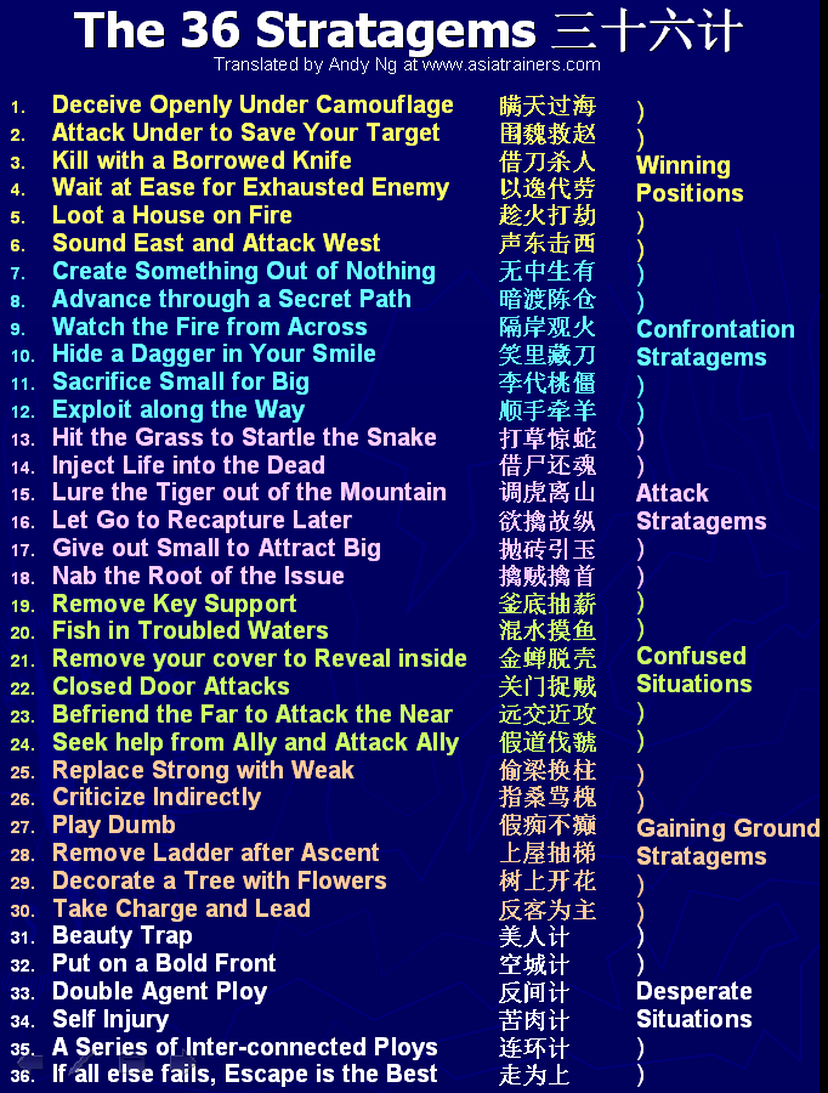
The List:

Strategems When Commanding Superiority
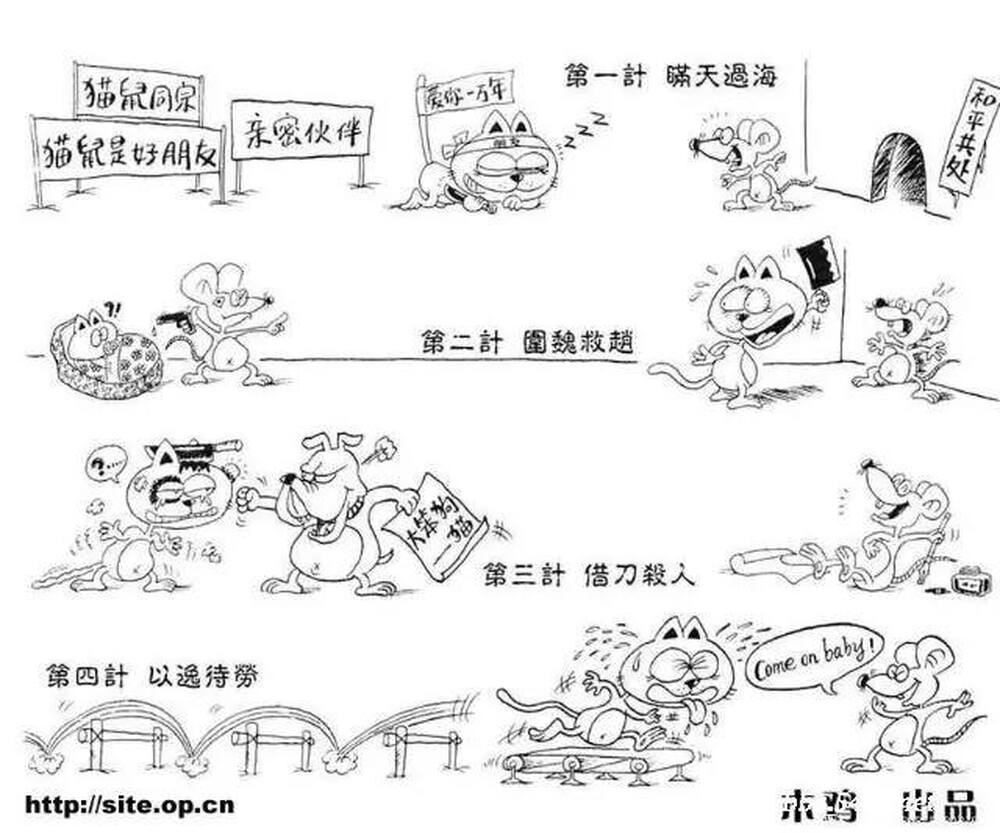
  1. 瞒天过海 Deceive the heavens and cross the ocean: Mask your real goals with a fake goal until your aims are achieved; the enemy will be so annoyed with the constant false alarms that they will ignore you once you make your real move. (This rule is also used as a Chinese idiom for "to pull the wool over someone's eyes".)
  2. 围魏救赵 Besiege Wei to rescue Zhao: Avoid a head-on battle with a strong enemy, and instead strike at his weakness(for example, a weaker ally) elsewhere. The name came from Qi forcing Wei's army to retreat from laying siege to Zhao's capital by laying siege to Wei's capital in 354-353BC.
  3. 借刀杀人 Kill With a Borrowed Knife: Cause damage to the enemy by getting a third party to do the deed or causing an Enemy Civil War.
  4. 以逸待劳 Substitute Leisure for Labor: Have your troops well-prepared for battle, in the same time that the enemy is rushing to fight against you, ideally resulting in their exhausted troops running into your fresh soldiers on the terms of your choosing.
  5. 趁火打劫 Loot a Burning House: The best time to attack an opponent is when they have their own problems to deal with. Though he who loots a burning house should be careful lest he become trapped inside.
  6. 声东击西 Clamor in the East, Attack in the West: Get the enemy to focus his forces elsewhere, and then attack a position that would be weakly defended.


Stratagems for Confrontation
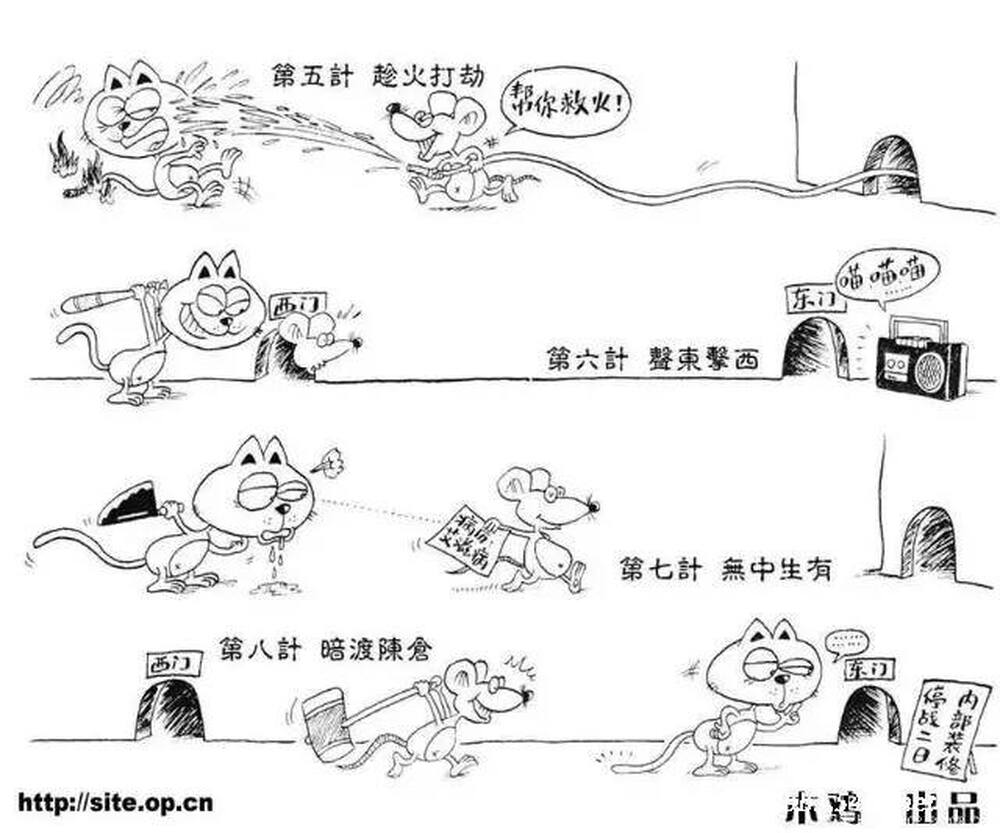
  1. 无中生有 Create Something from Nothing: Make somebody believe there was something when there is in fact nothing, or vice versa (i.e. lie like a rug). The general idea is that having fallen for a trick once or twice, an enemy will be unwilling to fall for your trick a third time - so that's when you should actually attack.
  2. 暗度陈仓 Openly Repair the Walkway, but Sneak through the passage of Chencang: Deceive the enemy with an obvious approach that will take a very long time, while surprising him by taking a shortcut and sneaking up on him. Another interpretation is the Kansas City Shuffle — Distract the enemy with an "obvious" attempt at deception in order to conceal yet another ploy from their attention.
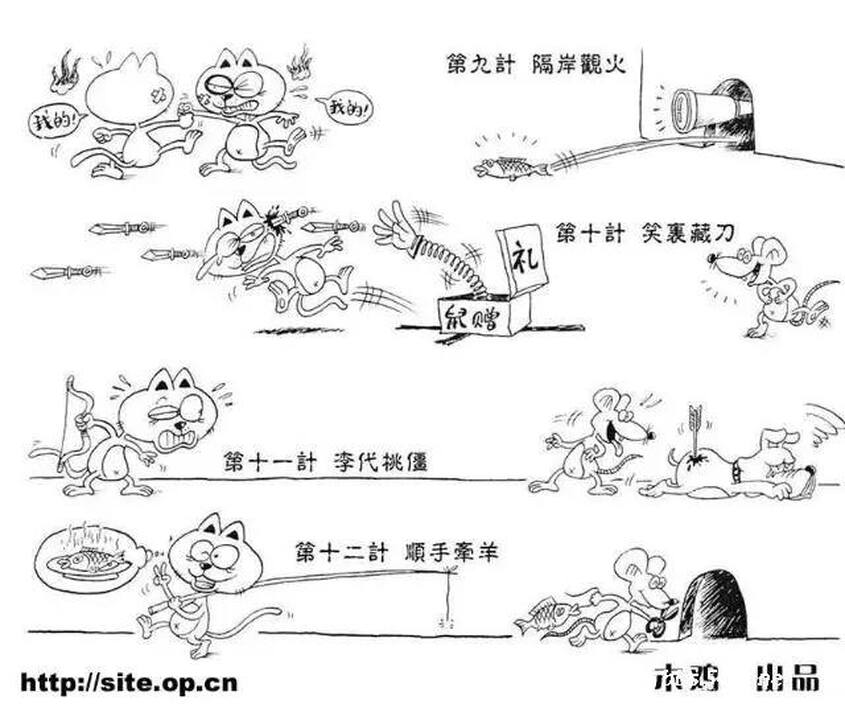
  3. 隔岸观火 Observe the Fire from the Opposite Shore, or Sit on the Mountain and Watch the Tigers Fight: Delay entering the field of battle until all the other players have become exhausted fighting amongst themselves, then go in at full strength and pick up the pieces.
  4. 笑里藏刀 Hide a Knife behind a Smile: Charm and ingratiate yourself to your enemy. When you have gained his trust, move against him in secret. (This rule is also used as a Chinese idiom for someone with Chronic Backstabbing Disorder.)
  5. 李代桃僵 Sacrifice the Plum Tree to Preserve the Peach Tree: Sacrifice short-term objectives in order to gain the long-term goal. (Peaches are associated with immortality; see eg. Journey to the West.)
  6. 顺手牵羊 Take the Opportunity to Pilfer a Goat: While carrying out your plans, be flexible enough to take advantage of any opportunity that presents itself, however small, and avail yourself of any profit, however slight. (This is also used as an idiom for Stealing from the Till or the Five-Finger Discount.)


Stratagems for Attack
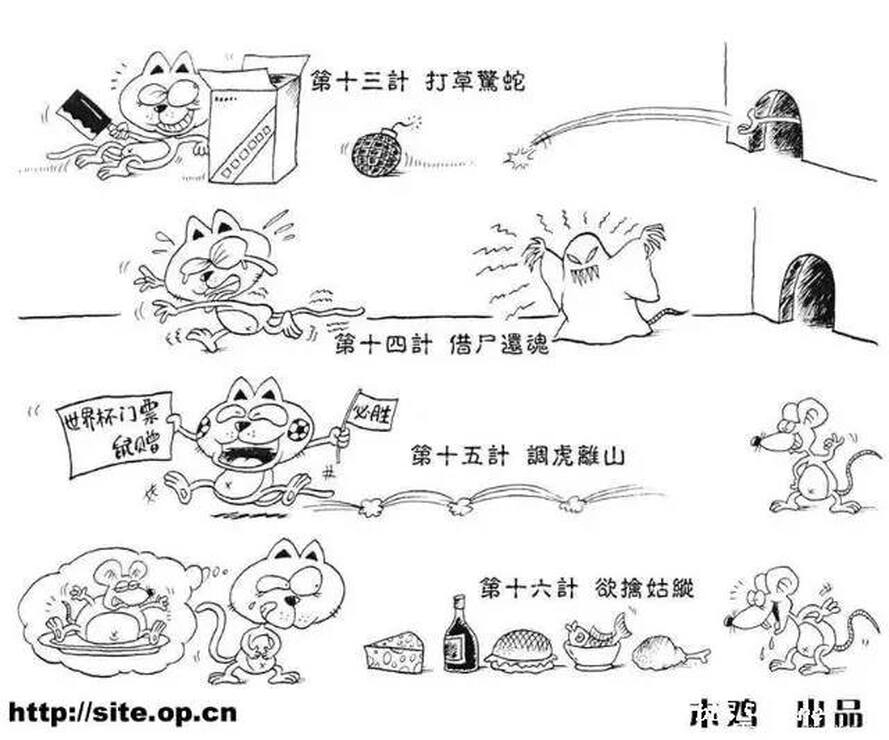
  1. 打草惊蛇 Beat the Grass to Startle the Snake: Do something without aim, but make it so spectacular to provoke a response of the enemy, thereby giving away his plans or position, or just taunt him. Do something unusual, strange, and unexpected as this will arouse the enemy's suspicion and disrupt his thinking. However, an imprudent act will give your position or intentions away to the enemy.
  2. 借尸还魂 Borrow a Corpse to Resurrect the Soul: Revive something from the past by giving it a new purpose, or reinterpret it to your advantage.
  3. 调虎离山 Lure the Tiger Down From the Mountain: Lure an opponent away from his field of advantage, thus separating him from his source of strength.
  4. 欲擒故纵 To Catch Something, First Set it Free: Cornered prey will often mount a final Desperation Attack; to prevent this, you let the enemy believe he still has a chance for freedom. May also take the form of a Trick-and-Follow Ploy, where letting an enemy go and observing their subsequent actions may give you more information about their capabilities and intentions.
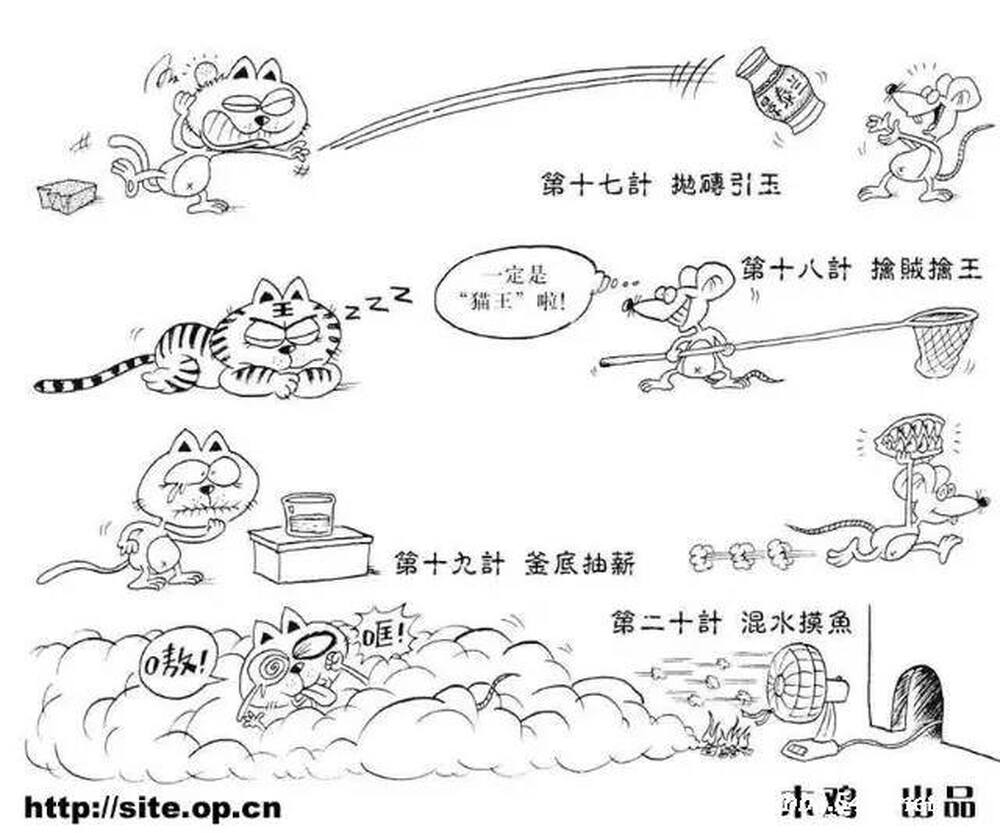
  5. 抛砖引玉 Toss out a Brick to attract Jade: Bait someone by making him believe he gains something or just make him react to it and obtain something valuable from him in return.
  6. 擒贼擒王 To Capture the Bandits, capture their Leader: If the enemy's army is strong but is allied to the commander only by money or threats, then take aim at the leader; the rest of the army will disperse or come over to your side. If, however, they are allied to the leader through loyalty, then beware, the army can continue to fight on after his death out of vengeance.


Stratagems for Confused Situations
  1. 釜底抽薪 Steal the Firewood from under the Pot: Take out the leading argument or asset of your target, denying your enemy the resources needed to oppose you.
  2. 浑水摸鱼 Stir up the Waters to catch a Fish: Create confusion and use this confusion to further your own goals.
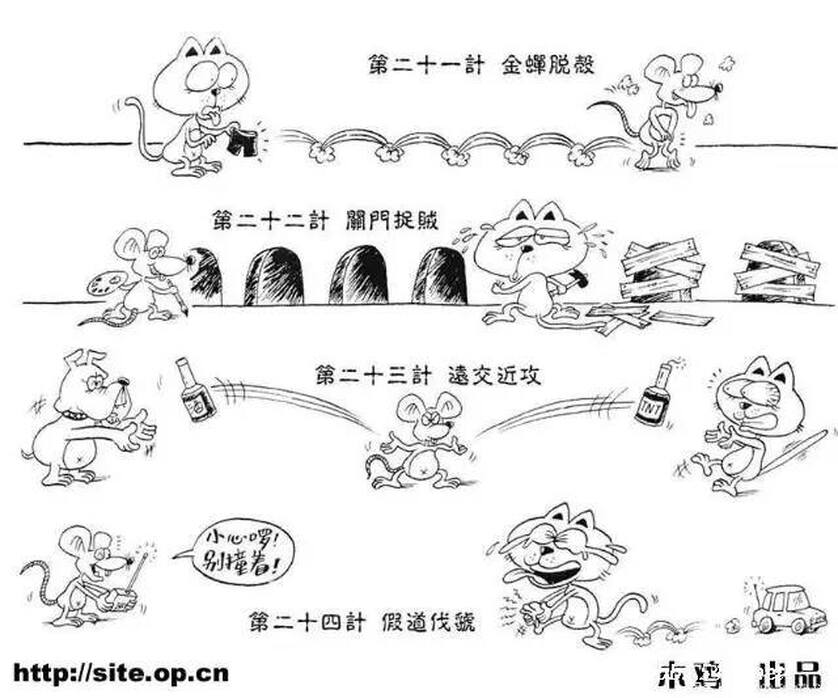
  3. 金蝉脱壳 Slough off the Cicada's Golden Shell: Create an illusion to fit your goals and distract others. (A secondary meaning for this rule would be Faking the Dead.)
  4. 关门捉贼 Shut the Door to catch the Thief: If you have the chance to completely capture the enemy then you should do so, thereby bringing the battle or war to a quick and lasting conclusion.
  5. 远交近攻 Befriend a Distant State while attacking a Neighbour: When you are the strongest in one field, your greatest threat is from the second strongest in your field, not the strongest from another field, and thus the distant neighbor will make a good ally, however temporary.
  6. 假道伐虢 Obtain Safe Passage to conquer the state of Guo: Borrow the resources of an ally to attack a common enemy. Once the enemy is defeated, use those resources to turn on the ally that lent you them in the first place. This comes from Jin's conquest of the states of Guo and Yu by bribing Yu's ruler to obtain a safe passage for Jin forces to conquer Guo in 658BC. Without Guo's protection, Yu was in turn conquered by Jin in 655BC.


Stratagems for Gaining Ground
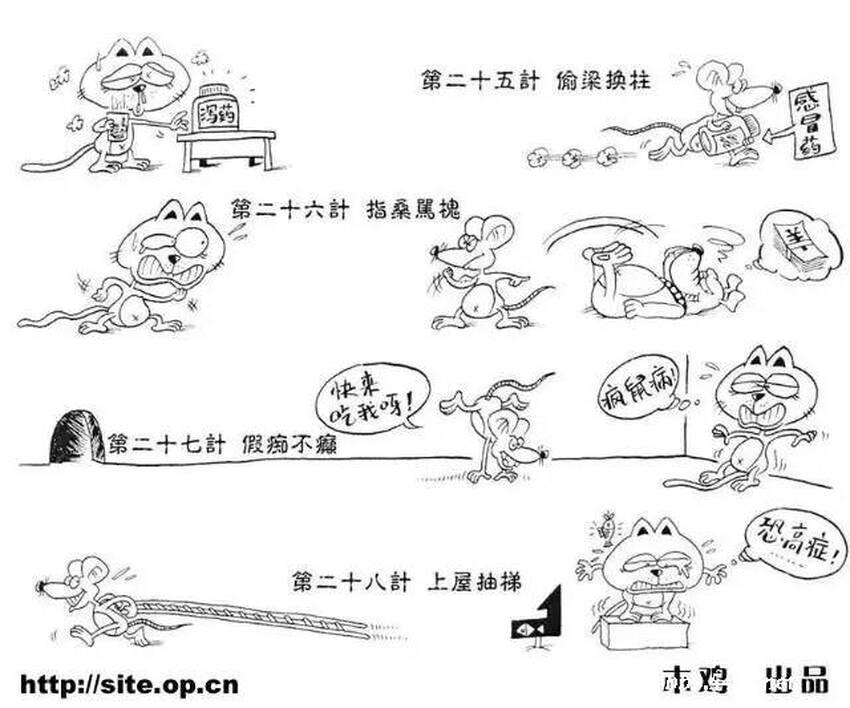
  1. 偷梁换柱 Replace the Beams with Rotten Timbers: Disrupt the enemy's formations, interfere with their methods of operations, change the rules which they are used to following, go contrary to their standard training.
  2. 指桑骂槐 Point at the Mulberry tree, but curse the Locust: To discipline, control, or warn others whose status or position excludes them from direct confrontation; use analogy and innuendo. Without directly naming names, those accusedcannot retaliate without revealing their complicity.
  3. 假痴不癫 Feign Madness but Keep your Balance: Hide behind the mask of a fool, a drunk, or a madman to create confusion about your intentions and motivations.
  4. 上屋抽梯 Lure them onto the Roof, then take away the Ladder: With baits and deceptions, lure your enemy into treacherous terrain, then cut off his lines of communication and avenue of escape; to save himself, he must fight both your own forces and the elements of nature.
  5. 树上开花 Deck the Tree with False Blossoms: Through the use of artifice and disguise, make something of no value appear valuable; of no threat appear dangerous; of no use appear useful.
  6. 反客为主 Exchange the roles of Host and Guest: Usurp leadership in a situation where you are normally subordinate. Infiltrate your target. Initially, pretend to be a guest to be accepted, but develop from inside and become the owner later.


Stratagems for Desperate Straits
  1. 美人计 The Beauty Trap: Send your enemy beautiful women to cause discord within his camp. This strategy can work on three levels: First, the ruler becomes so enamored with the beauty that he neglects his duties and allows his vigilance to wane; second, other males at court will begin to display aggressive behavior that inflames minor differences hindering co-operation and destroying morale; third, other females at court, motivated by jealousy and envy, begin to plot intrigues, further exacerbating the situation.
  2. 空城计 The Empty Fort Strategy: When the enemy is superior in numbers and your situation is such that you expect to be overrun at any moment, then drop all pretense of military preparedness and act calmly so that the enemy will thinkyou have hidden reserves and want to trap them into the fort.
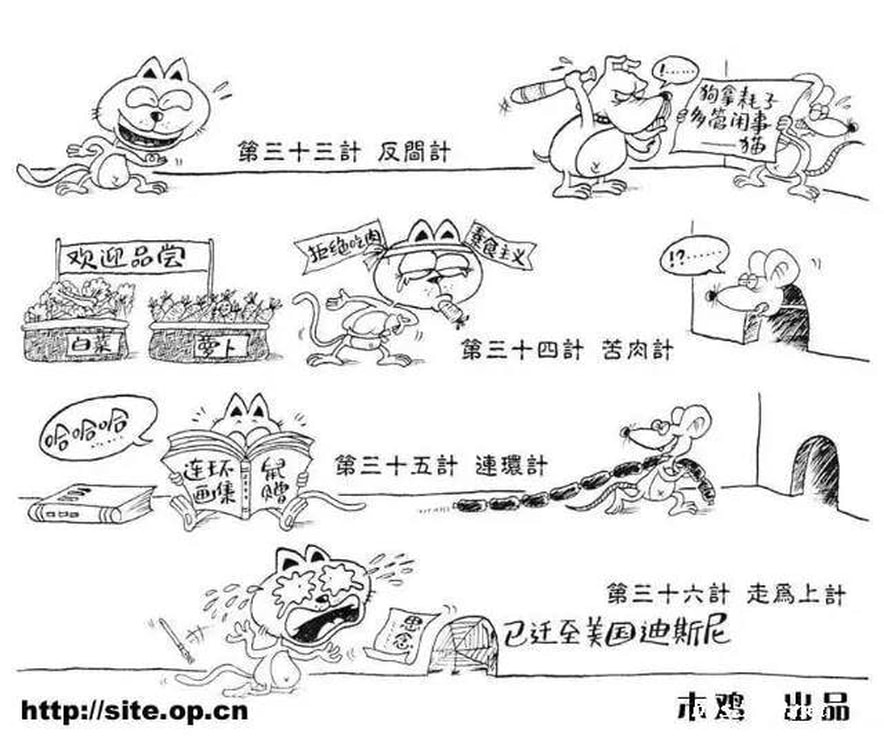
  3. 反间计 Let the Enemy's own spy sow discord in the Enemy camp: Undermine your enemy's intelligence-gathering abilities by using his own spies against him or planting your own agents among his.
  4. 苦肉计 Injure yourself to gain the Enemy's trust: Pretending to be injured has two possible applications. In the first, the enemy is lulled into relaxing his guard since he no longer considers you to be an immediate threat. The second is a way of ingratiating yourself to your enemy by pretending the injury was caused by a mutual enemy.
  5. 连环计 Chain Stratagems: In important matters, one should use several stratagems applied simultaneously after another as in a chain of stratagems. Keep different plans operating in an overall scheme; however, in this manner if any one strategy fails, then the chain breaks and the whole scheme fails.
  6. 走为上计 If all else fails, Retreat: The best battle is one fought with your side never having to mobilize, but if it becomes obvious that your current course of action will lead to defeat, then retreat and regroup.
Picture


​Comic Strip:

Picture
Picture
Picture
Picture

Picture
Picture
Picture
Picture

Powered by Create your own unique website with customizable templates.